
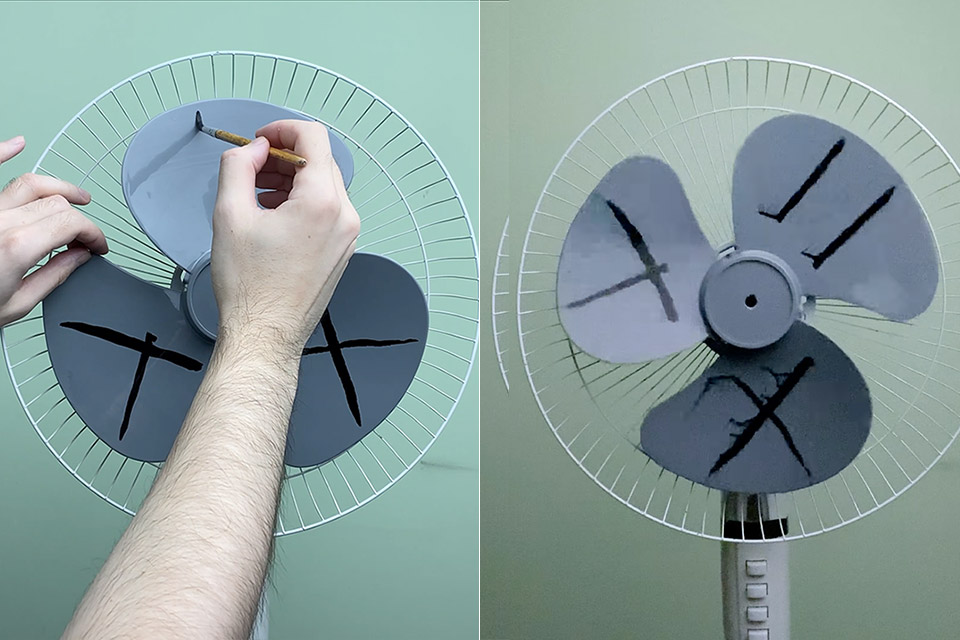
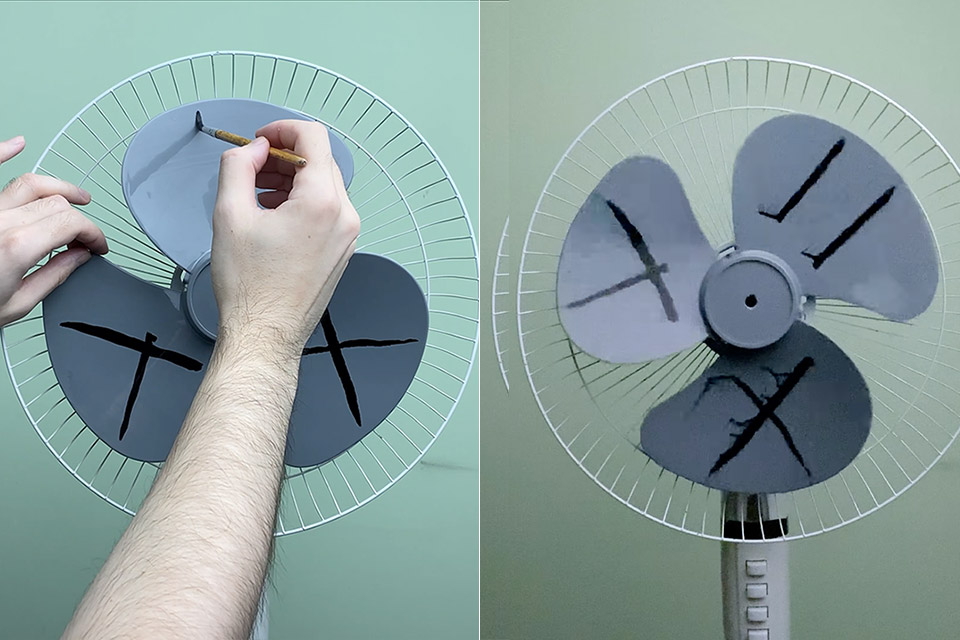
Pavel Mamontov, known as Lensevision, marked three distinct symbols onto the blades of an ordinary desk fan and then spent time hunting for the exact rotational speed that would make those blades appear motionless to a video camera recording at 30 frames per second.
The end result is a clear depiction of the stroboscopic effect seen in movies, where helicopter rotors or automobile wheels appear to stand still or even travel backward, which is quite mesmerizing. So here comes Mamontov, armed with a potentiometer to fine-tune the fan’s speed and pinpoint the precise moment when it settles on the appropriate speed. The problem is that the motor itself cannot maintain a constant speed for long periods of time.
Sale
DJI Osmo Pocket 3 Vlogging Camera with 1” CMOS & 4K/120fps Video | 3-Axis Stabilization, Fast Focusing…
- Capture Stunning Footage – Osmo Pocket 3 vlogging camera features a 1-inch CMOS sensor and records in 4K resolution at an impressive 120fps. Capture…
- Effortlessly Frame Your Shots – Get the ideal composition with Osmo Pocket 3’s expansive 2-inch touch screen that rotates for both horizontal and…
- Ultra-Steady Footage – Say goodbye to shaky videos! Osmo Pocket 3’s advanced 3-axis mechanical stabilization delivers superb stability. Enjoy smooth…
His first attempts resulted in the blades being frozen in place as the surrounding symbols shifted between frames, but when he looked closely, he discovered that between each exposure, the fan moved just enough for the following blade to match up with the one that came before it. That made the overall shape appear rather static, despite the fact that the marks were clearly moving with each successive frame.
You might get an even more unusual effect by adjusting the speed slightly: the blades would appear to be spinning the opposite direction or swaying back and forth, depending on whether the fan was spun a little faster or slower than needed to match the photo. The strange thing was that many slightly varying speeds could all generate the identical static image, as each corresponded to the point at which the blade lined up exactly the same way from one frame to the next.
When Mamontov eventually hit one of the matching speeds, both the blades and their individual symbols remained fixed in place over multiple frames. The fan was still spinning at full speed in real life, but the camera only captured the exact seconds when each blade matched itself back up exactly the same way.
A faster shutter speed keeps the edges sharper by reducing the blur that occurs while any single blade is still moving during the brief exposure. The same principle appears in everyday footage of spinning objects whenever their rotation happens to line up with the camera’s frame rate, which is why the effect can show up without any special equipment beyond a phone and a fan.
[Source]
What Happens When You Perfectly Sync a Camera to Fan Blades
#Perfectly #Sync #Camera #Fan #Blades
