
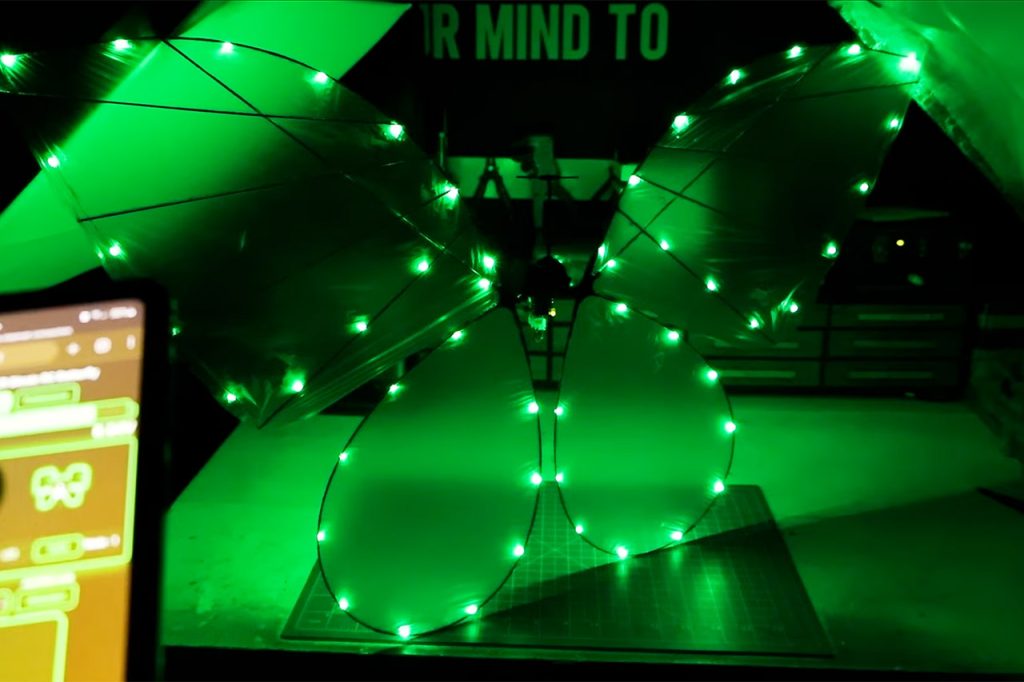
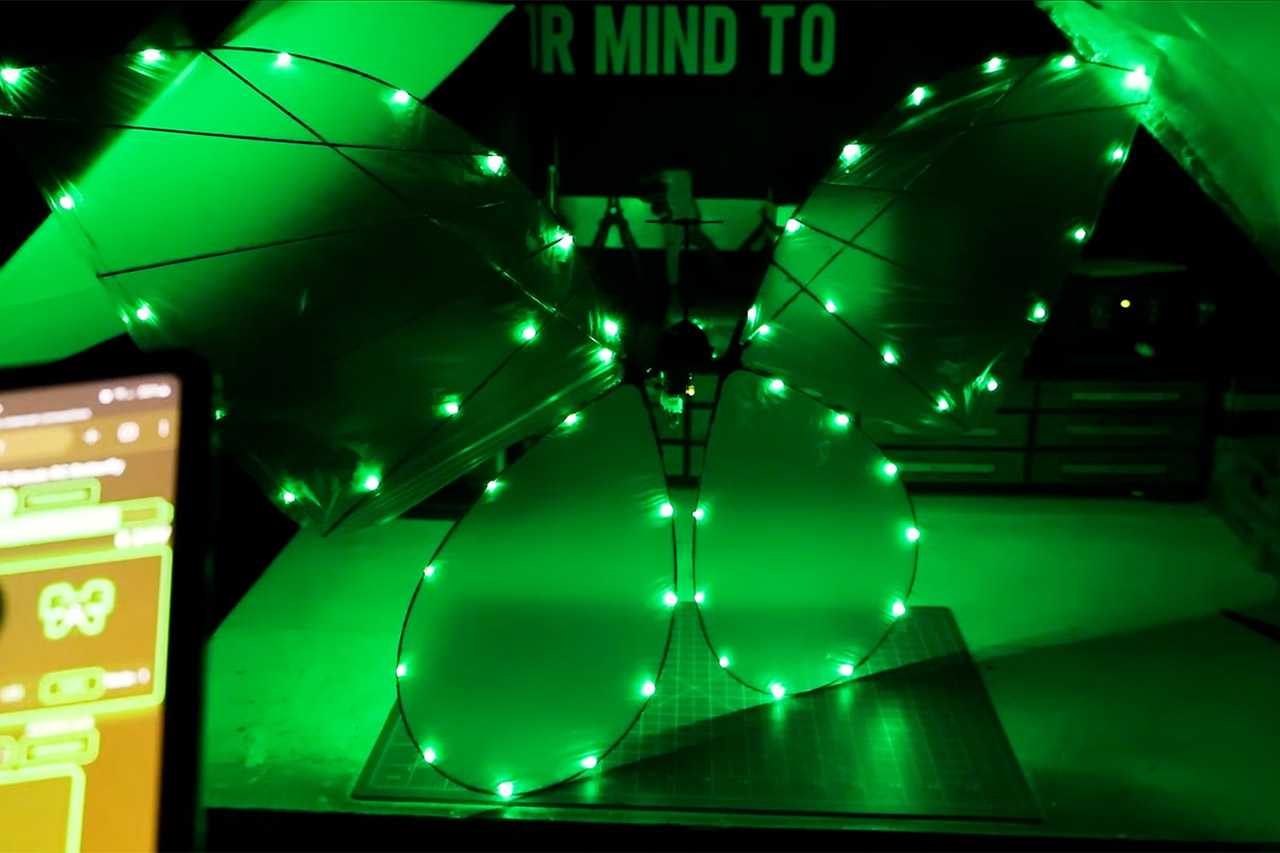
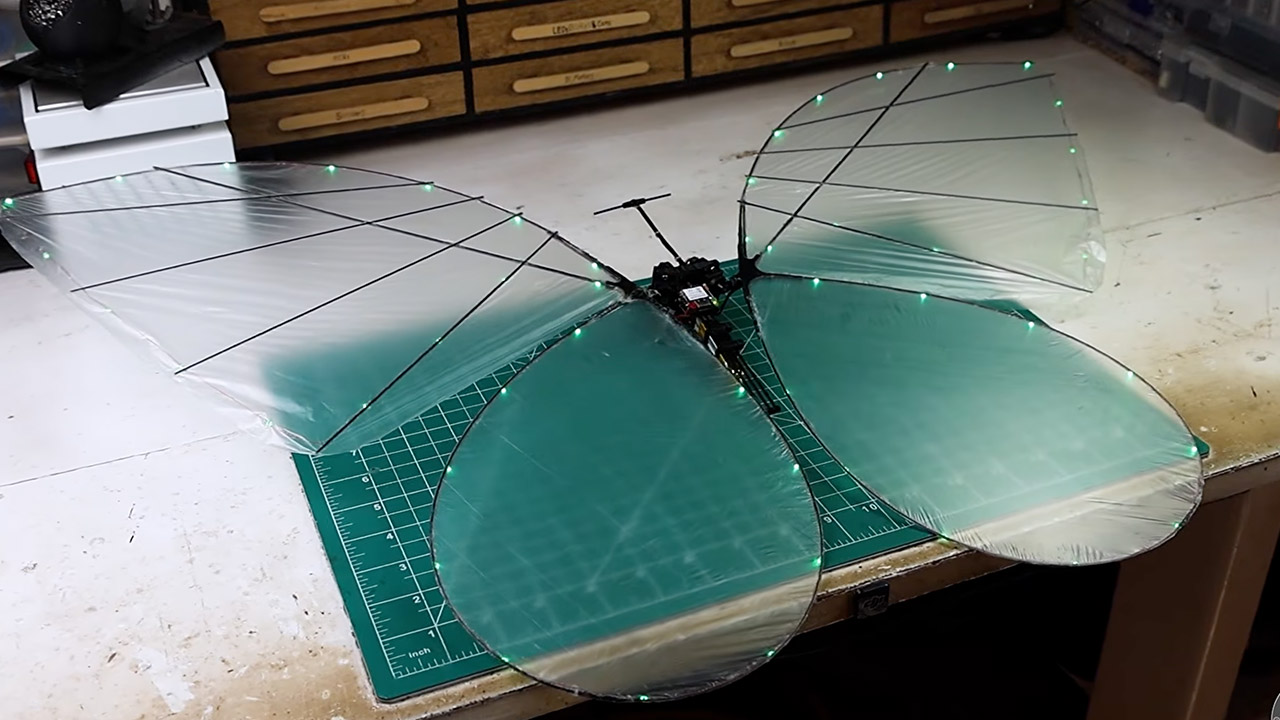
Max Imagination set out to build a remote-controlled butterfly that could leave the ground under its own power, and ESP-FLUTTER manages exactly that. Weighing 70 grams complete with battery, the machine relies on two high-speed coreless digital servos to drive independent wings rather than a single motor and linkage. Those wings stretch thin plastic from supermarket produce bags across carbon-fiber rods, then carry roughly 50 tiny surface-mount LEDs per side wired with fine enameled copper. The result is an ornithopter that generates both lift and thrust through flapping motion while remaining light enough to stay airborne.
Ordinary hobby servos cannot deliver the speed and torque required to make wing strokes worthwhile, so Imagination used SDS1601 servos in conjunction with a Seeed Studio XIAO ESP32-C3. The microprocessor sends continuous position commands, which are either smooth sine waves for more even flapping or triangular waves to generate lift. You can change anything on the fly, including frequency, amplitude, how high and low the wings can go, and the neutral pitch angle. Flipping the wings involves making one go through a larger motion than the other, which is a fairly simple and effective method of giving the pilot control in all directions because it is a differential amplitude phenomenon. After determining the center of gravity, we discovered that a fairly consistent 4 Hz at full power began to function.

Bambu Lab A1 mini 3D Printer + LED Lamp Kit, Ready-to-Use for Beginners | Beginner-Friendly Ecosystem…
- A1 mini + LED Lamp Kit for Creative Light Projects: Bring your ideas to life with the included LED Lamp Kit. Simply print compatible lamp models and…
- The Perfect 3D Printer for Beginners: A1 mini 3D Printer is designed to make 3D printing easy from day one with automatic calibration, simple setup…
- Experience the Bambu Lab Ecosystem: Access MakerWorld’s huge library of ready-to-print models, manage prints through the Bambu Handy app, and enjoy…
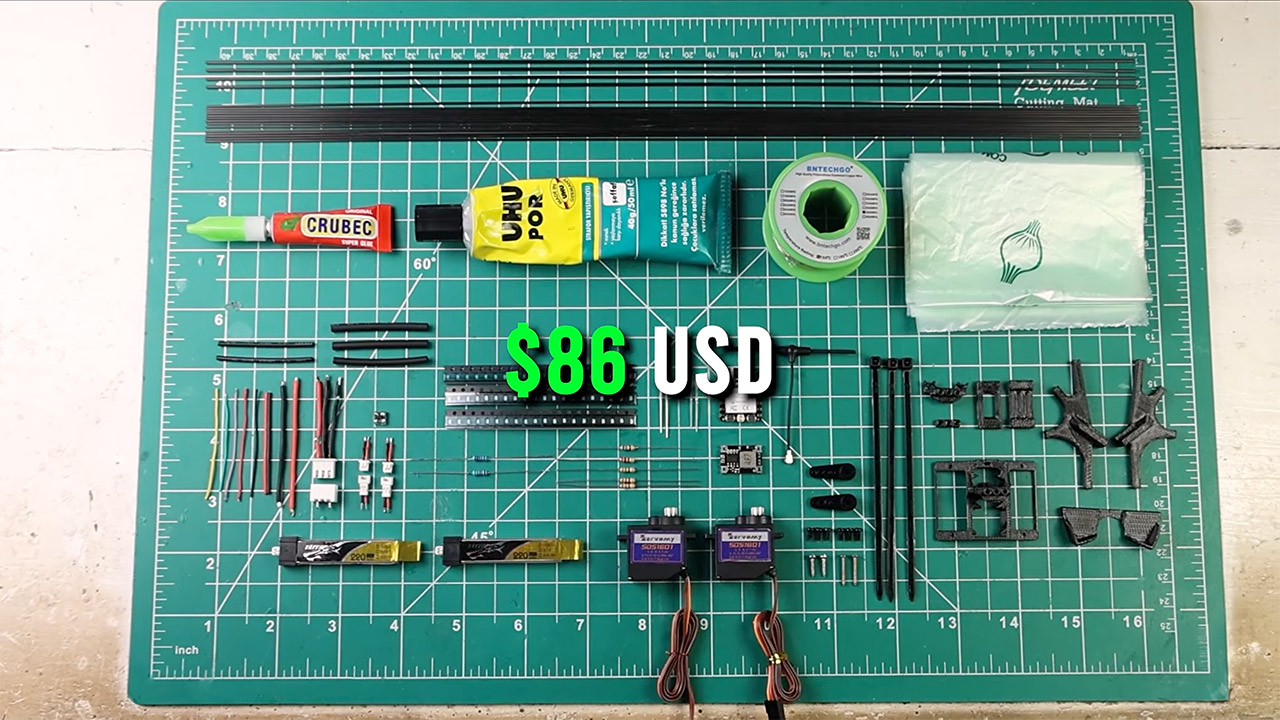
Building it came down to two options: a modular build that mounts the ESP32-C3, a small buck converter, and associated bits on a perforated board inside a PETG frame with TPU crash guards and carbon rods for good measure, or a PCB version that crams all of the same electronics onto a four-layer board from JLCPCB. Both use a custom 2 cell 220 mAh LiPo battery pack, and both wings begin as chopped pieces of carbon rod welded into a lightweight skeleton before being wrapped in that flimsy plastic film, stretched over a wire frame, and attached with a bit of flexible glue. Some LED strips are also included, adding about a gram to each wing. He spent some time adjusting the battery fore and aft, and eventually tuned the tail so that the machine did not dip or pitch back upon launch. Early crashes taught him that it’s basically easier to remain calm and carry on than to merely add more power.
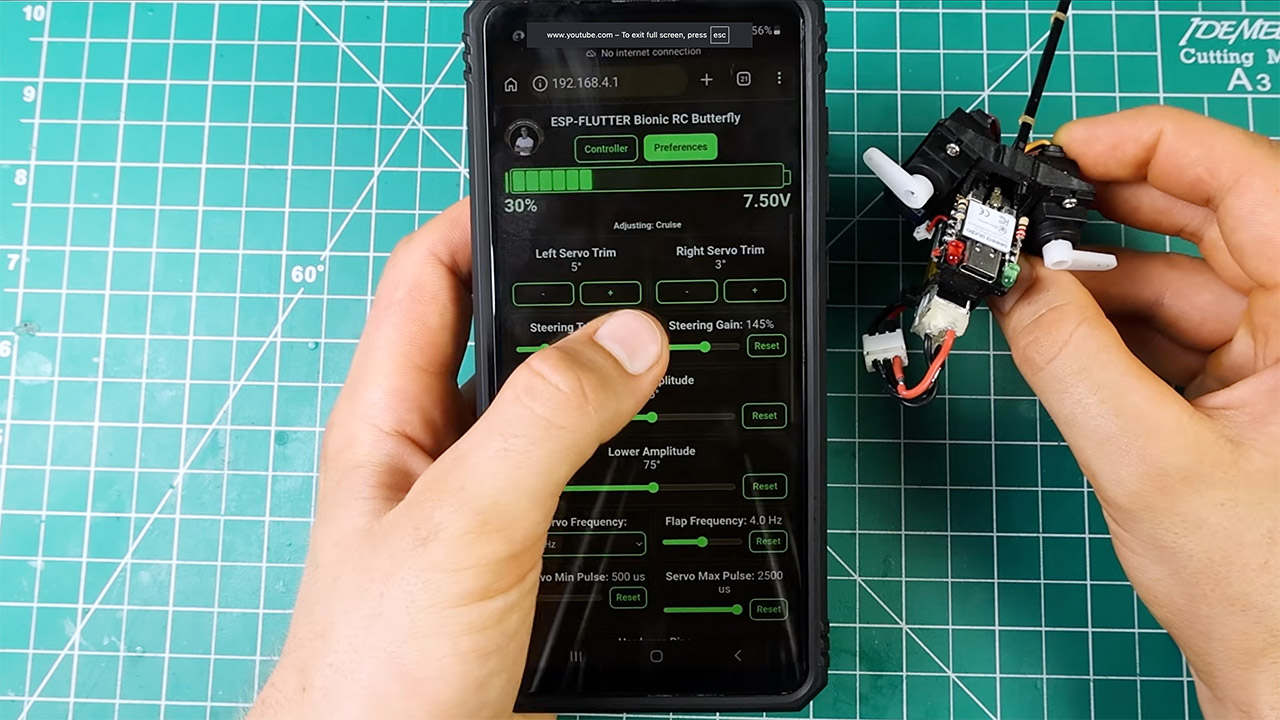
Control comes from a phone browser that connects to the butterfly’s Wi-Fi network and lands on a web interface with an on-screen joystick, a tilt option, and realtime sliders for each motion parameter. Then there’s the ability to save three alternative profiles: Cruise, Sport, and Hover, each with a different frequency, amplitude, and steering sensitivity level. If you prefer to use a proper radio transmitter, an ExpressLRS receiver or ESP-NOW link is your best option. Battery voltage is displayed in the same interface, allowing you to increase the amplitude when the battery pack sags, preventing lift from expiring. He achieved the longest continuous flight of 1 minute and 9 seconds thus far, and gets roughly 5 minutes out of a single charge, as long as the pilot takes a break to compensate for a low battery. The signal travels approximately 25 meters before being lost in the commotion of the wings and rods. At night, the LEDs cycle between solid, fade, and strobe patterns, transforming the entire airplane into a dazzling sight.
Firmware, Gerber data, plans, and a bill of materials are all available on a GitHub page and shared drive, allowing anyone with a 3D printer and a soldering iron to start from the same design. All modular pieces will cost you roughly $86, minus tools and delivery. There is no fancy autopilot system, so the pilot will have to keep the wings level and make those launches smooth, which normally involves a forward whack at the right moment to get things started on a downward arc. Once things settle down, ESP-FLUTTER will contentedly hang in the air or glide forward, resembling a real bug rather than a boring old model airplane. The best part is that everything is open source, so the next version may come from anywhere; simply grab an ESP32 and a couple of nice servos from your neighborhood shop and you’re ready to go.
[Source]
Max Imagination’s ESP-FLUTTER Turns Plastic Bags into a Flying Remote-Controlled Butterfly
#Max #Imaginations #ESPFLUTTER #Turns #Plastic #Bags #Flying #RemoteControlled #Butterfly
